
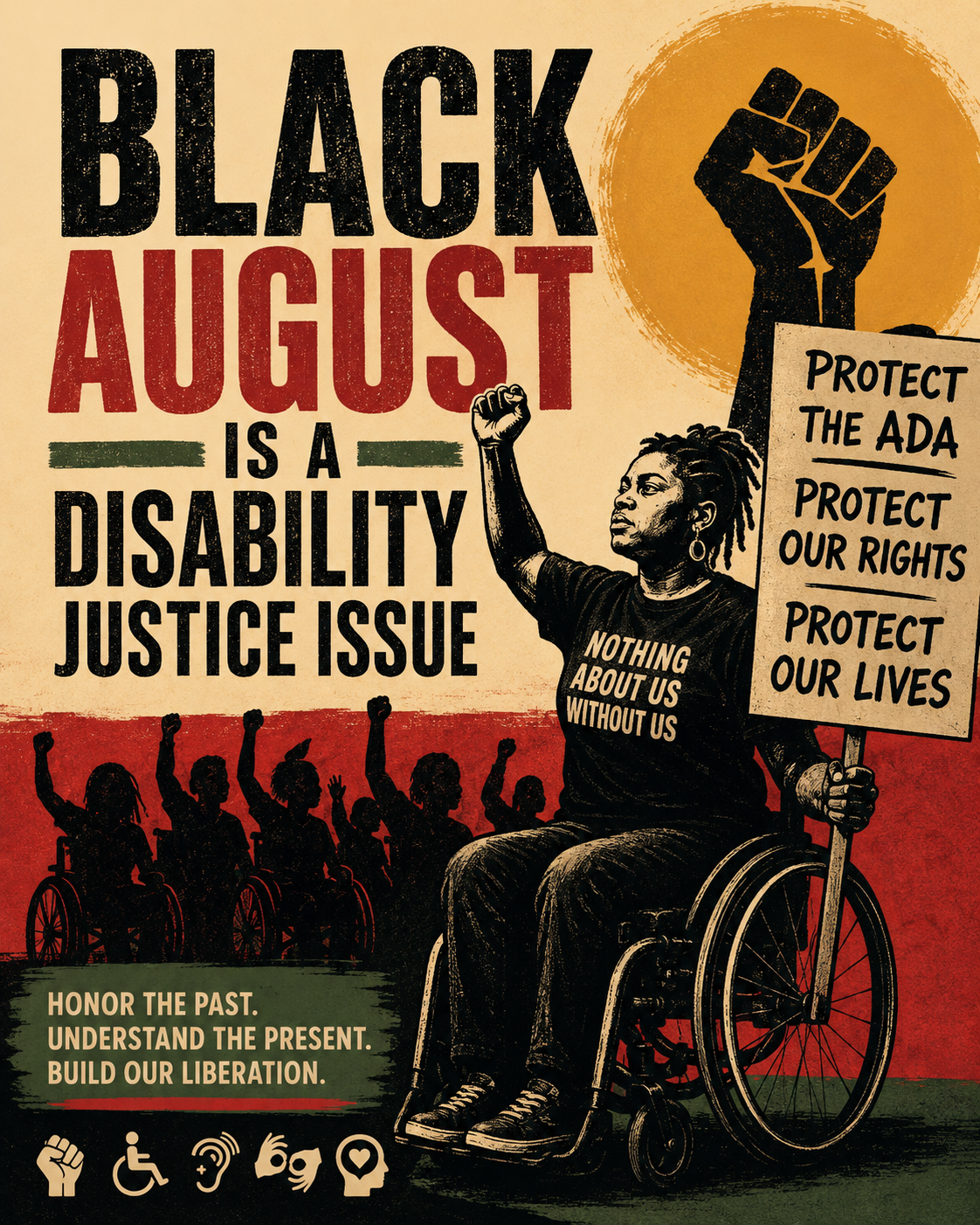
Every August, Black August asks us to remember.
But remembrance is not passive.
Black August was born inside California prisons in the late 1970s as a practice of honoring Black freedom fighters and political prisoners and studying the long history of Black resistance. It calls us to remember those who resisted state violence, incarceration, racism, and oppression—and to recognize that the struggle for Black liberation did not end with the movements or people we read about in history books.
For those of us committed to Disability Justice, Black August also asks us to examine something that is too often left out of conversations about Black liberation: the relationship between racism, ableism, incarceration, institutionalization, and disability.
These systems have never existed separately.
And at a moment when the rights guaranteed to disabled people under the Americans with Disabilities Act are facing renewed threats, understanding that relationship is especially urgent.
Black August and Disability Justice
Black August originated within the prison system, where incarcerated Black people created a tradition rooted in study, reflection, discipline, remembrance, and resistance.
That history matters to Disability Justice because incarceration itself is a disability issue.
Disabled people are disproportionately represented throughout the criminal legal system. Black disabled people, meanwhile, experience the compounded consequences of racism and ableism in encounters with policing, incarceration, healthcare, education, housing, and other institutions.
Disability can increase someone’s exposure to policing and incarceration. Policing and incarceration can also create, worsen, or leave disabilities untreated.
Inside jails and prisons, disabled people may face inaccessible facilities, inadequate medical care, isolation, barriers to communication, denial of accommodations, and conditions that exacerbate existing disabilities or create new ones.
The connection extends beyond prisons.
Disability Justice asks us to examine every system that decides who gets to live freely in community and who is confined, controlled, segregated, surveilled, or institutionalized.
That includes prisons and jails.
It includes psychiatric institutions.
It includes nursing facilities.
It includes immigration detention centers.
And it includes policies that make it harder for disabled people to obtain the supports necessary to live safely and independently in their own communities.
For Black disabled people, these systems cannot be understood without also confronting the histories of anti-Blackness that shaped them.
Black Disabled People Have Always Been Part of the Movement
Black disability history is Black history.
One person whose legacy makes that connection especially clear is Brad Lomax.
Lomax was a Black Panther, a disability rights organizer, and a wheelchair user with multiple sclerosis. He helped found the East Oakland Center for Independent Living and participated in the historic 1977 Section 504 Sit-in in San Francisco.
The Black Panther Party supported the protesters during the sit-in, including providing meals while disabled activists occupied a federal building for weeks demanding enforcement of Section 504 of the Rehabilitation Act.
That history disrupts the idea that the Black freedom struggle and the disability rights movement developed independently from one another.
They intersected because people’s lives intersected.
Black disabled organizers understood that racism and ableism could not simply be separated into different movements. Their organizing helped build the foundation for disability civil rights protections that generations of disabled people would later depend upon.
Thirteen years after the 504 Sit-in, the Americans with Disabilities Act became law.
The ADA Was Never the Finish Line
The Americans with Disabilities Act is one of the most significant civil rights laws in United States history.
It prohibits disability discrimination across major areas of public life and established protections that disabled people have spent decades using to demand access to employment, government services, transportation, businesses, public spaces, and community life.
But the ADA did not eliminate ableism.
A law cannot, by itself, dismantle a system.
Disabled people have continued to fight for enforcement, accessibility, community-based services, healthcare, education, employment, transportation, digital access, and the basic right to participate in public life.
And today, some of those protections are becoming less certain.
In 2026, federal actions have raised serious concerns about the future of disability civil rights enforcement.
The Department of Justice extended compliance deadlines for accessibility requirements covering state and local government websites and mobile applications. More recently, the Department announced that it would no longer rely on longstanding federal guidance regarding the ADA’s integration mandate and Olmstead v. L.C. while it reexamines that guidance.
That matters.
The Olmstead decision affirmed a principle disabled activists have fought for generations to establish: disabled people should not be unnecessarily segregated in institutions when they can receive services in integrated community settings.
For many disabled people, community-based services are not simply a policy preference.
They are the difference between freedom and confinement.
We Have Seen What Happens When Rights Are Treated as Optional
This is where Black August offers an important lesson.
Rights that exist on paper require people willing to defend them.
The ADA did not appear because institutions voluntarily decided to become accessible.
Section 504 was not enforced because the federal government simply recognized that disabled people deserved equality.
The disability rights movement organized.
People protested.
People occupied buildings.
People disrupted systems that had excluded them.
Black disabled organizers were part of that resistance.
And generations before them understood something movements continue to teach us today: progress is neither inevitable nor permanent.
Civil rights protections can be weakened.
Enforcement can disappear.
Deadlines can be delayed.
Institutions can return to practices movements fought decades to dismantle.
That is why Disability Justice cannot begin and end with compliance.
Disability Justice Demands More Than Access
The ADA matters enormously.
But Disability Justice asks us to imagine beyond what the ADA alone can provide.
It asks us not only whether a building has a ramp, but whether disabled people can afford housing.
Not only whether a website is technically accessible, but whether disabled people have access to information, technology, healthcare, education, and political participation.
Not only whether discrimination is prohibited, but whether Black disabled people can encounter healthcare providers, schools, police, employers, and government institutions without racism and ableism shaping how their bodies, communication, intelligence, pain, and needs are perceived.
And not only whether disabled people can leave institutions, but whether communities have the resources necessary for disabled people to live there with dignity.
Disability Justice asks us to move from access to liberation.
That distinction is especially important during Black August.
Because liberation cannot mean freedom for only those whose bodies and minds are considered acceptable.
Black liberation must include Black disabled people.
Our Freedom Is Connected
Black August reminds us that resistance has always required memory.
We remember the people who organized before us not simply to celebrate what they accomplished, but to understand what their struggles require from us now.
The history of Black resistance and the history of disability resistance are not separate stories.
They meet in people like Brad Lomax.
They meet in struggles against incarceration and institutionalization.
They meet whenever Black disabled people demand autonomy over our bodies, access to our communities, and the right to exist without being controlled, confined, or discarded.
And they meet again in this moment, as disability civil rights protections face uncertainty.
The ADA is not perfect.
It was never the endpoint of Disability Justice.
But the protections generations of disabled people fought to establish must not be treated as disposable.
Black August teaches us that freedom must be defended, expanded, and reimagined by every generation.
Our responsibility is not simply to preserve what previous movements won.
It is to continue what they started.
Because there is no Black liberation without Disability Justice.
And there is no Disability Justice without the freedom to live, move, communicate, participate, and exist fully in our communities.
Learn More
Black August and Disability Justice are rooted in histories of resistance, organizing, community care, and the ongoing struggle for liberation. We encourage you to continue learning about the people, movements, and policies shaping these conversations.
Black August: A History of Resistance
Learn more about the origins of Black August, its connections to incarcerated Black freedom fighters, and its continued significance as a time for study, reflection, and resistance.
Brad Lomax and the Black Panther Party
Explore the life and legacy of Brad Lomax, a Black disabled activist and member of the Black Panther Party whose organizing helped connect the Black liberation and disability rights movements. Lomax participated in the historic 1977 Section 504 Sit-in, while the Black Panther Party provided critical support to disabled protesters during the occupation.
The 504 Sit-In and the Fight for Disability Civil Rights
Learn about the historic 1977 protests demanding enforcement of Section 504 of the Rehabilitation Act and the disabled activists whose organizing helped establish a foundation for later disability civil rights protections, including the Americans with Disabilities Act.
The Americans with Disabilities Act
Explore the history of the ADA, the protections it established, and the decades of disability organizing that made its passage possible. Understanding that history is especially important as disabled communities continue to advocate for meaningful enforcement and resist efforts that could weaken disability civil rights.
Olmstead v. L.C. and the Right to Live in Community
Learn more about the landmark 1999 Supreme Court decision affirming that unjustified segregation of disabled people can constitute discrimination under the ADA. The fight for community-based services and against unnecessary institutionalization remains central to Disability Justice today.
Disability Justice and the Criminal Legal System
Continue exploring the intersections of disability, race, policing, incarceration, and institutionalization. Understanding how ableism and anti-Blackness operate together is essential to building movements in which freedom and community are possible for all of us.
Black August asks us not only to remember, but to study. These histories give us tools for understanding the present—and for imagining what liberation can look like beyond it.
You can access our August resource here.
