
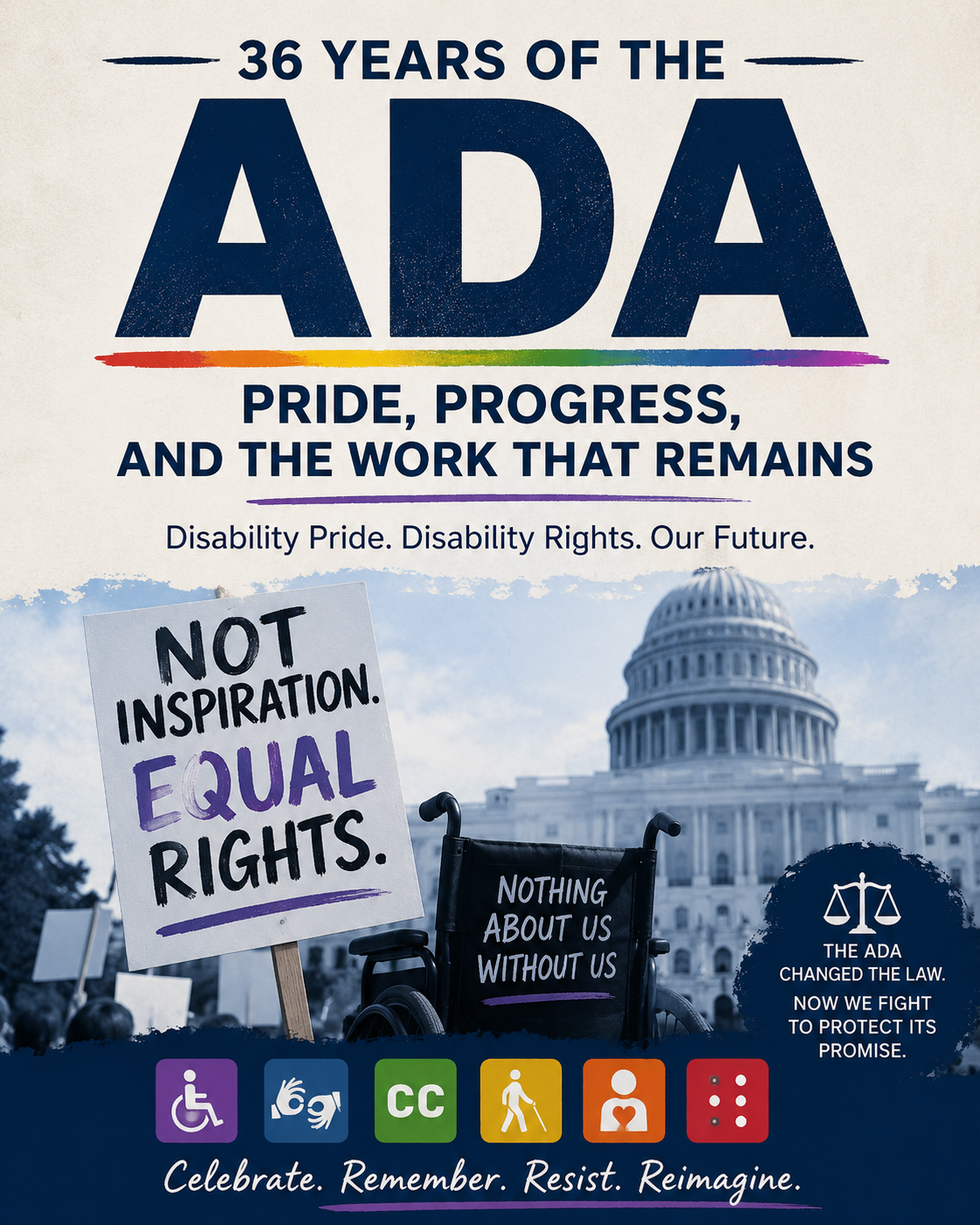
This year marks 36 years since the Americans with Disabilities Act (ADA) was signed into law on July 26, 1990. The ADA represented a monumental shift in the fight for disability rights, affirming that disabled people belong in our schools, workplaces, communities, and public life. It has opened doors that were once firmly closed and created legal protections that generations of disabled activists fought tirelessly to secure.
For that progress, we celebrate.
But celebration and honesty can exist at the same time.
Throughout Disability Pride Month, many in the community have reflected on how far we’ve come while recognizing how much work remains. Thirty-six years later, accessibility is still treated as an afterthought. Disabled people continue to face barriers to employment, housing, education, healthcare, transportation, and community life. Pride in our identities has always existed alongside the ongoing work of demanding equity.
Today, that work feels more urgent than ever.
Across the country, disability rights are increasingly being questioned, challenged, and weakened. Legal protections that many assumed were settled are now being scrutinized. Policies affecting healthcare, education, civil rights enforcement, and community living have left many disabled people wondering what protections will remain tomorrow.
It’s difficult to celebrate progress when the foundation beneath that progress feels uncertain.
For many disabled people, Disability Pride is about embracing an identity that society has long taught us to hide, fix, or apologize for. It is choosing community over shame, visibility over invisibility, and self-worth over stigma.
But pride does not develop in isolation.
How do you fully embrace your disability identity when public conversations suggest your access is negotiable? When accommodations are framed as inconveniences? When lawmakers debate whether your civil rights should be strengthened, limited, or enforced at all? When disabled lives are repeatedly treated as less worthy of investment, protection, or belonging?
These messages, whether spoken directly or communicated through policy decisions, have consequences.
They shape how disabled children see themselves. They influence whether young adults feel comfortable requesting accommodations. They reinforce the idea that disabled people should simply be grateful for whatever access they receive instead of expecting equal opportunity as a matter of civil rights.
For disabled people who also navigate racism, sexism, homophobia, transphobia, immigration barriers, poverty, or other forms of oppression, those messages become even heavier. The experience of Disability Pride is never separate from the systems that determine whose rights are protected and whose humanity is questioned.
This is why Disability Pride Month cannot simply be about celebration.
It must also be about remembrance.
It must remind us that the ADA did not appear because people in power decided it was time. It exists because disabled people organized, protested, litigated, educated, and refused to accept exclusion as inevitable. Every curb cut, interpreter, caption, accessible entrance, workplace accommodation, and legal protection reflects decades of collective advocacy.
The ADA has always required people willing to defend it.
As we mark 36 years of this landmark legislation, we honor everyone who made it possible, and everyone who continues that work today. Progress is real. So are the challenges before us. Both can be true.
Disability Pride is not the absence of fear or frustration. It is the decision to continue showing up despite them.
Pride means believing that disabled people deserve to exist fully in our communities, not because the law says so, but because our humanity has never depended on legislation. The ADA recognizes those rights; it did not create them.
Thirty-six years later, our commitment remains the same: to protect the rights we’ve fought for, to expand the rights we have yet to secure, and to build a future where disabled people are not merely included, but valued, respected, and free to thrive.
The ADA changed the law.
Now we must ensure its promise continues to become reality.
As we continue reflecting on Disability Pride Month, we invite you to deepen your understanding of this history. This month, we’ve created two resources exploring the origins of Disability Pride Month and how it began, why it matters, and the history behind the flag. Understanding where we’ve been helps us better understand where we are now, and why protecting disability rights remains as important as ever.
We hope these resources encourage you to learn, reflect, and join us in carrying this work forward.
